
Share
Need Urgent Stock or Better Pricing for These Components?
Published: July 26, 2026
📊 Week 30, 2026 — Electronics Component Industry Highlights
📅 July 20 – July 26, 2026
AI demand is no longer constrained by compute alone.
Power delivery, sensing, storage, and supporting materials are becoming the next bottlenecks.
And the market’s high-end / low-end split is widening again.
Week 30 brought another clear structural shift.
TSMC’s stronger capital-spending outlook reinforced confidence in long-term AI infrastructure growth.
But at the component level, the pressure moved deeper into the system:
- high-current power ICs
- automotive power stages
- enterprise memory
- industrial sensing
- interface modules
- oscillators
- active filters
- and advanced passive components
The market is no longer only competing for processors.
It is competing for everything required to keep high-performance systems powered, connected, monitored, and stable.
🌏 Global Industry Overview
Week 30 was shaped by three major forces:
1️⃣ Advanced-node and packaging investment accelerated again
2️⃣ Enterprise memory remained under controlled allocation
3️⃣ AI power demand created a new sourcing bottleneck
The industry’s two-track structure also became more visible.
On one side:
- AI infrastructure
- advanced process nodes
- high-current power
- enterprise storage
- automotive electronics
- sensing and industrial control
continued to attract capital and allocation.
On the other side:
- low-end consumer PMICs
- conventional display drivers
- basic interface devices
- and mature-node commodity parts
remained under inventory pressure.
The market is not simply tight or loose.
It is tight where system value is highest
and weak where end-market pricing power is lowest.
🏭 Advanced Process Capacity — TSMC Raises the Ceiling
The most important upstream signal this week came from TSMC.
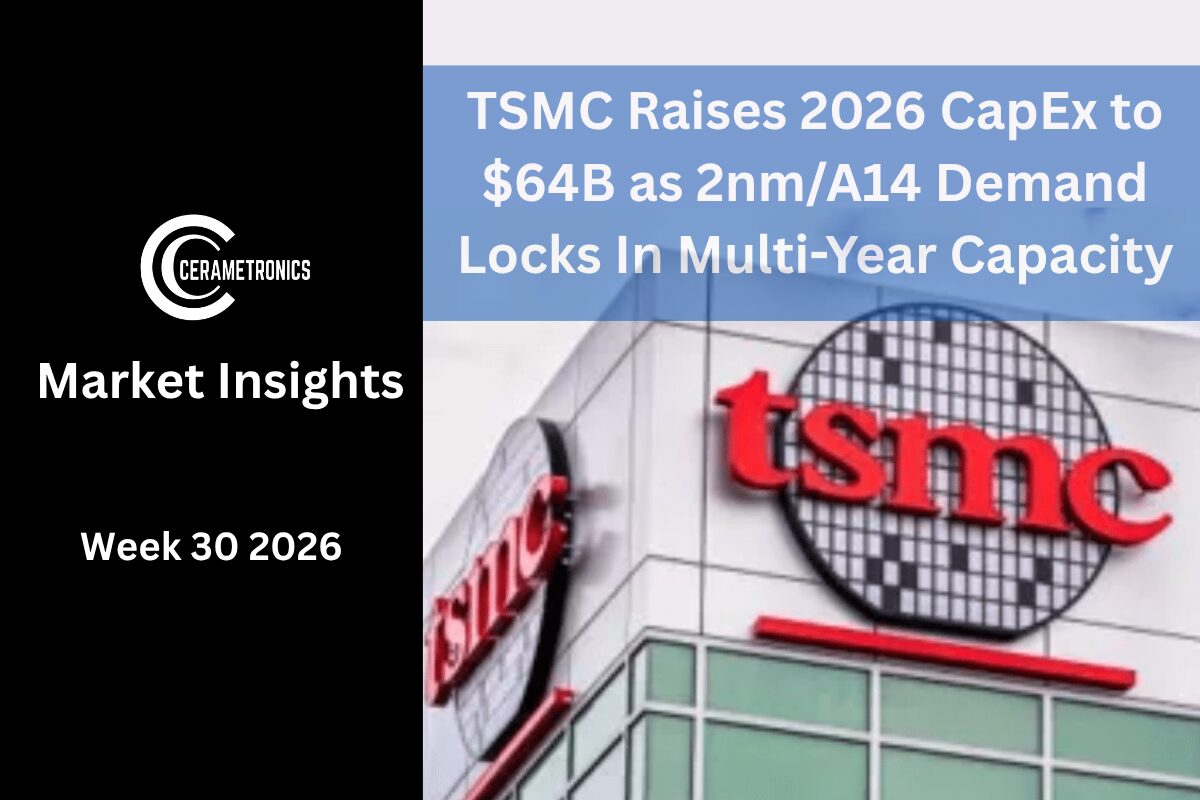
The company raised its 2026 capital-spending ceiling from approximately $56B to $64B, with the majority directed toward:
- 2nm and other advanced process nodes
- future A14 development
- advanced packaging
- high-performance computing capacity
- and AI-related infrastructure
The broader message is significant.
AI demand is being treated as a multi-year structural cycle rather than a temporary investment wave.
Advanced-node revenue already represents the dominant share of TSMC’s business, and demand from hyperscalers continues to lock capacity far ahead.
However, higher investment does not mean immediate relief.
The expansion itself creates pressure on:
- CoWoS
- silicon interposers
- high-end substrates
- specialty chemicals
- advanced packaging equipment
- and qualified local supply chains
The constraint is shifting from one manufacturing layer to the next.
⚡ AI Power Delivery — The Next Supply-Chain Bottleneck
AI server power density continued to rise sharply.
Next-generation accelerator platforms and server racks are increasingly operating around:
- 1,500W
- 2,000W
- and, in some configurations, even higher power envelopes
That puts greater pressure on 48V and high-current architectures.
The most exposed component groups include:
- Smart Power Stages
- high-voltage PMICs
- gate drivers
- DrMOS devices
- high-current MOSFETs
- isolated drivers
- current-sense devices
- and high-voltage MLCCs
Selected lead times reportedly remained in the 28–32 week range.
The procurement challenge is no longer only getting the processor.
It is building a stable power-delivery chain around it.
🧠 Memory Market — Channels Continue to Hold the Line
Enterprise storage and server memory remained tightly controlled.
The most affected segments include:
- DDR5 RDIMM
- 8TB and 16TB enterprise SSD
- LPDDR
- high-density NAND
- and HBM-adjacent products
Distribution channels continued to use:
- quota-based approvals
- 48-hour rolling quotations
- weekly allocation reviews
- and selective inventory release
Spot premiums remained elevated relative to contract pricing.
With major memory suppliers approaching earnings season, channel participants continued to protect inventory and avoid aggressive spot selling.
The result:
pricing is high, but open-market availability is still limited.
📈 Top Demand Models
Core search demand softened across several established models:
- STM32F405RGT6 ↓ 43.13%
- STM32F103C8T6 ↓ 39.42%
- STM32H743VIT6 ↓ 0.07%
- STM32F407VET6 ↓ 32.61%
- W25Q128JVSIQ ↑ 2.77%
- TPS82130SILR ↑ 2.87%
- TPS5430DDAR ↓ 13.19%
- STM32F103RCT6 ↓ 42.27%
- W25Q64JVSSIQ ↑ 12.66%
- MT41K256M16TW-107:P ↑ 13.99%
Read-through
The broad STM32 basket cooled after several strong weeks.
But the underlying demand mix shifted rather than disappeared.
Search momentum improved in:
- SPI Flash
- DRAM
- compact power modules
- and confirmed storage-related builds
The near-flat movement in STM32H743VIT6 also suggests that higher-performance embedded platforms retained stronger support than many lower-end MCU lines.
The market is becoming more selective within the MCU category itself.
🚀 Top Demand Surges
This week’s strongest model surges were:
- L9945TR ↑ 595.00%
- LMR38020SDDAR ↑ 544.84%
- 88E1510-A0-NNB2C000 ↑ 513.71%
- TLF35584QVVS1 ↑ 353.96%
- ATMEGA128L-8AU ↑ 311.88%
- TPS2553DBVR ↑ 290.03%
- MT53E256M32D2DS-053 AAT:B ↑ 289.52%
- BTS3408G ↑ 277.12%
- EP3C10E144C8N ↑ 274.53%
- UCC27211AQDDARQ1 ↑ 267.58%
Signal analysis
Week 30 demand surged in:
- automotive power control
- high-efficiency buck regulation
- Ethernet PHYs
- automotive safety power management
- legacy embedded MCUs
- USB power switches
- LPDDR memory
- high-side power switches
- FPGA
- and automotive gate drivers
This is a strong automotive and industrial systems signal.
The market is prioritizing:
power control, networking, functional safety, memory, and programmable logic.
💸 Price Movements
🔺 Top Price Increases
- CD4046BE ↑ 290.75%
- AT24C02D-SSHM-T ↑ 290.55%
- IPD30N10S3L-34 ↑ 281.31%
- B560C-13-F ↑ 279.84%
- HEF4021BT ↑ 277.00%
- MMDT3904-7-F ↑ 276.70%
- 4N35 ↑ 275.38%
- MT47H128M8SH-25E IT:M ↑ 269.40%
- BAS16 ↑ 269.26%
- 74HC08D ↑ 269.24%
🔻 Top Price Declines
- BAS16L ↓ 95.95%
- IRF7241TRPBF ↓ 95.00%
- TPS54320RHLR ↓ 94.59%
- SD36C-01FTG ↓ 94.23%
- UF4007 ↓ 94.22%
- PMV213SN,215 ↓ 93.70%
- PESD12VL1BA ↓ 93.13%
- MAX3232IDR ↓ 92.92%
- MIC29502WU ↓ 91.94%
- MT40A1G16TB-062E IT:F ↓ 91.72%
Market interpretation
Price strength appeared in:
- EEPROM
- MOSFETs
- legacy logic
- optocouplers
- DRAM
- signal diodes
- and discrete power components
Sharp corrections appeared in:
- commodity diodes
- selected MOSFETs
- DC/DC regulators
- ESD protection
- RS-232 interfaces
- LDOs
- and DRAM variants
The market remains extremely fragmented.
Even within the same product family, packaging, qualification level, lifecycle status, and channel availability can produce very different price behavior.
📦 Inventory Dynamics
📈 Inventory Surges
- KLMBG1UCTC-B041 ↑ 13,899.57%
- NCA3176-DSPR ↑ 9,793.39%
- MT40A2G8VA-062E IT:B ↑ 3,047.94%
- NCE60P82AK ↑ 2,443.00%
- ADS131B04QPWRQ1 ↑ 2,263.59%
- 0603WAF1002T5E ↑ 1,825.35%
- MTFC128GBCAQTC-IT ↑ 1,744.19%
- AP66300FVBW-13 ↑ 1,574.80%
- GDQ3BFAM-WJ ↑ 1,466.86%
- OP2177ARMZ ↑ 1,390.48%
📉 Inventory Declines
- NSI8260S0-DSSR ↓ 99.93%
- H9QT1G6DN6X132 ↓ 99.90%
- STM32G491KEU6 ↓ 99.81%
- ISL68221IRAZ-T ↓ 99.66%
- CRG40T65AK5SD ↓ 99.48%
- AD5724AREZ ↓ 99.47%
- H5CG58MHBDX051N ↓ 99.38%
- F60C1A0004-M79W ↓ 99.27%
- MT53E1G32D2FW-046 WT:C ↓ 99.20%
- REG1117-3.3 ↓ 98.73%
Inventory read-through
Inventory increased in:
- eMMC
- DRAM
- power MOSFETs
- automotive ADCs
- chip resistors
- managed Flash
- and precision operational amplifiers
But inventory declined sharply in:
- isolation
- high-density memory
- STM32G4 MCUs
- digital power controllers
- IGBT / high-power devices
- precision DACs
- LPDDR
- and LDO regulators
The tightest areas continue to include:
advanced memory, digital power, isolation, high-performance MCU, and precision conversion.
🧠 Brand Momentum
Top Demand Brands
TI • ADI • ST • onsemi • Nexperia • Diodes • Microchip • Infineon • Tech Public • UMW
Fastest-Rising Brands
- RALEC ↑ 171.70%
- Solomon Systech ↑ 94.49%
- Lontium ↑ 55.98%
- OmniOn ↑ 51.45%
- Viking ↑ 43.44%
- Knscha ↑ 38.97%
- Seiko ↑ 38.71%
- Advanced Energy ↑ 33.39%
- Maxim ↑ 28.27%
- Artesyn ↑ 25.63%
Signal
This week’s brand momentum points toward:
- resistors and passive networks
- display and interface ICs
- video connectivity
- industrial power
- timing
- legacy analog
- and power-conversion systems
The pattern is broader than semiconductor shortages.
Buyers are actively reviewing the supporting system stack:
passives, display, timing, interface, and power infrastructure.
📊 Category Momentum
Top Demand Categories
- Microcontrollers
- MOSFETs
- DC-DC Converters and Switching Regulators
- Operational Amplifiers
- Linear Regulators
- Flash
- Rectifiers
- FPGA
- MLCC
- DRAM
Fastest-Growing Categories
- Industrial Pressure Sensors ↑ 44.32%
- Interface Modules ↑ 41.67%
- Active Filters ↑ 41.51%
- Silicon Oscillators ↑ 33.41%
- Modulation and Demodulation ↑ 27.19%
- Proximity Sensors ↑ 26.72%
- Ambient Light Sensors ↑ 23.67%
- Magnetoresistive Sensors ↑ 23.57%
- Development Kits and Tools ↑ 22.27%
- Touchscreen Controllers ↑ 22.17%
What does this tell us?
Week 30 category momentum shifted strongly toward:
- industrial sensing
- interface expansion
- signal conditioning
- timing
- wireless and RF control
- environmental sensing
- magnetic position detection
- development platforms
- and human-machine interfaces
This suggests increased activity in:
industrial automation, edge systems, smart equipment, robotics, and connected control platforms.
🔌 Supporting BOM — The Shortage Moves into the System
One of the most important signals this week is that supply pressure continues to move beyond the main processor.
AI and industrial systems depend on a much larger supporting BOM:
- pressure and proximity sensors
- isolated interfaces
- oscillators
- active filters
- resistors
- high-voltage MLCC
- power switches
- interface modules
- and connectors
This creates a new procurement challenge.
A project may have secured the MCU or accelerator, yet still miss its shipment schedule because of a relatively small supporting component.
The next bottleneck is increasingly likely to appear in the parts that receive the least attention during early planning.
🌍 Origin Compliance Expands into Tier-2 and Tier-3 Suppliers
Geographic compliance reviews continued to move deeper into the supply chain.
The review now extends beyond finished chips into:
- substrate materials
- ceramic components
- packaging compounds
- optical interconnect materials
- adhesives
- and specialized PCB inputs
This means traceability requirements are becoming more detailed.
Suppliers increasingly need to prove:
- where materials were sourced
- where components were assembled
- where testing occurred
- and whether sub-tier suppliers meet approved-region rules
The cost of compliance is rising.
But so is the commercial value of a fully traceable supply chain.
🧹 Excess Inventory from Failed AI Programs
The consolidation of the AI accelerator ecosystem continued to create excess inventory downstream.
Programs that failed OEM qualification are leaving suppliers with:
- custom connectors
- high-frequency inductors
- specialty PCB materials
- thermal parts
- and dedicated power components
These items may not be broadly interchangeable.
That raises the risk of:
- write-downs
- distressed inventory sales
- credit losses
- and long-term obsolete stock
The market is therefore experiencing two opposite inventory cycles:
critical AI infrastructure parts remain short, while components tied to unsuccessful platforms are being liquidated.
🧭 Cerametronics Weekly Insight — Week 30
Week 30 confirmed that the AI infrastructure cycle remains structurally strong.
But the sourcing challenge is changing.
The strongest signals came from:
- automotive power control
- Ethernet connectivity
- LPDDR and enterprise storage
- gate drivers
- FPGA
- industrial pressure sensing
- interface modules
- active filters
- oscillators
- and advanced power systems
The biggest takeaway:
AI expansion is creating a second bottleneck beyond compute and memory.
That bottleneck is the supporting system architecture:
- power delivery
- sensing
- isolation
- timing
- signal conditioning
- and qualified passive components
At the same time, consumer-grade and lower-margin mature-node products remain under inventory pressure.
The market’s two-track structure is becoming more permanent.
🔹 Watchlist
Automotive and high-current power
L9945*
TLF35584*
BTS3408*
UCC27211*
ISL68221*
Memory and storage pressure zone
MT53E256*
MT53E1G32*
MT40A2G8*
MTFC128G*
KLMBG1U*
Industrial networking and interfaces
88E1510*
interface modules
isolated interfaces
modulation / demodulation ICs
Industrial sensing
pressure sensors
proximity sensors
ambient-light sensors
magnetoresistive sensors
Timing and signal conditioning
silicon oscillators
active filters
precision op-amps
ADC / DAC families
Supporting BOM
RALEC
Viking
MLCC
chip resistors
development kits and tools
Correction-sensitive lines
BAS16L*
PESD12V*
MAX3232*
MIC29502*
commodity rectifiers and low-voltage PMICs
✨ Stay ahead with Cerametronics — your success is our priority.
📬 Sign up for our email notifications and never miss key market moves:
Apply Now ➡️ https://www.cmtelec.com/8
#Cerametronics #Week30 #Semiconductor #AIInfrastructure #PowerManagement #Memory #IndustrialSensors #AutomotiveElectronics #FPGA #SupplyChain #Procurement #Pricing #Inventory #Electronics #MarketInsights
Sourcing components mentioned in this article?
Inquire About These Components →Need Urgent Stock or Better Pricing for These Components?
Week 38, 2026 — Electronics Component Industry Highlights
🔥 Verified Spot Stock Available for Week 38 Allocation Items We have physically verified, factory-sealed inventory ready for immediate dispatch (48-Hour Express Shipping): TPS25830AQWRHBRQ1
Week 37, 2026 — Electronics Component Industry Highlights
🔥 Verified Spot Stock Available for Week 37 Allocation Items We have physically verified, factory-sealed inventory ready for immediate dispatch: TPS53513RVER (TI DCDC Converter)
Week 36, 2026 — Electronics Component Industry Highlights
📊 Week 36, 2026 — Electronics Component Industry Highlights 📅 August 31 – September 6, 2026 Week 36 is the first full week after
Week 35, 2026 — Electronics Component Industry Highlights
📊 Week 35, 2026 — Electronics Component Industry Highlights 📅 August 24 – August 30, 2026 Week 35 marks the final trading and procurement
STAY IN THE LOOP