
Need Urgent Stock or Better Pricing for These Components?
Published: August 9, 2026
📊 Week 32, 2026 — Electronics Component Industry Highlights
📅 August 3 – August 9, 2026
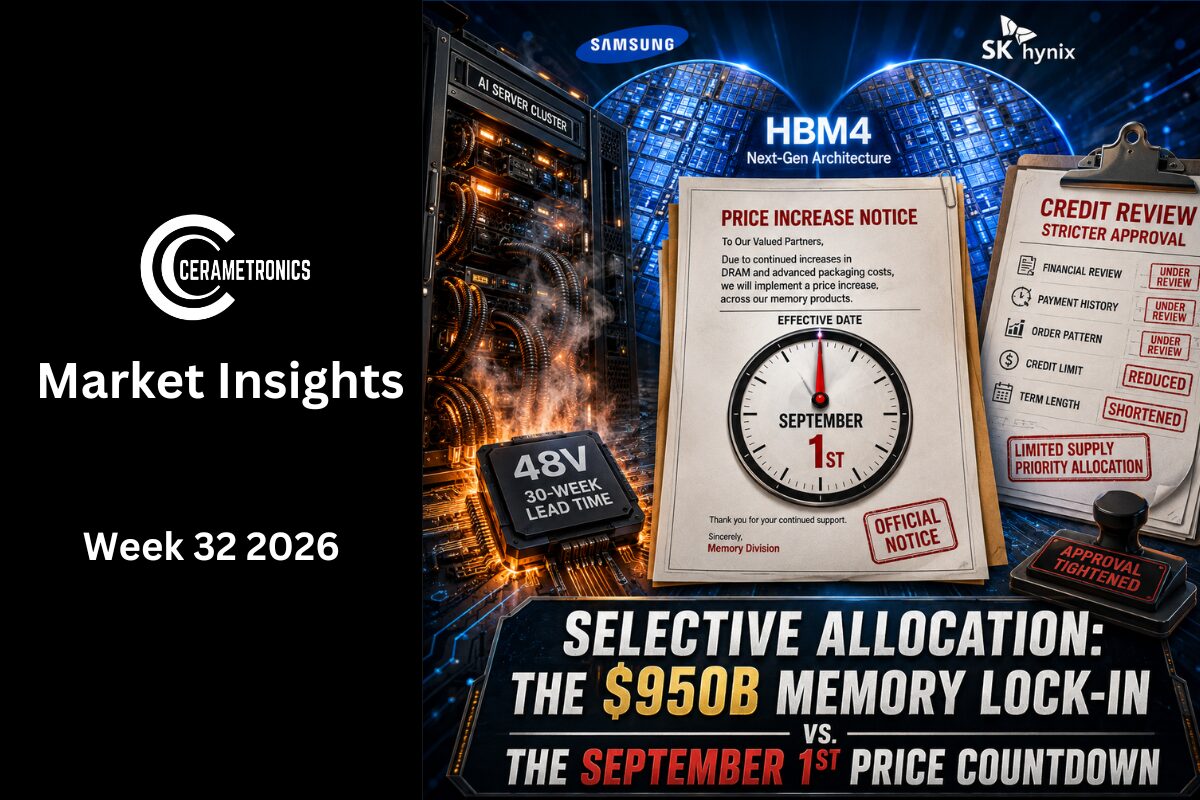
September’s price reset is only weeks away.
AI allocation is tightening again.
And procurement teams are shifting from “buying cheaper” to “designing safer.”
Week 32 marked another important stage in the semiconductor market’s transition toward a Selective Allocation Market.
Q2 earnings season is drawing to a close, but the message from the supply chain is becoming clearer:
- premium AI capacity remains tightly allocated
- enterprise memory continues to stay expensive
- 48V power components are moving deeper into shortage territory
- OEMs are accelerating pre-September purchasing
- and second-source qualification is becoming standard procurement policy
The market is no longer simply divided between shortage and oversupply.
It is increasingly divided between strategic allocation and ordinary inventory.
🌏 Global Industry Overview
Week 32 was shaped by four major forces:
1️⃣ AI-related memory capacity remained heavily committed through long-term agreements
2️⃣ The September pricing deadline triggered another wave of early purchasing
3️⃣ High-current power IC lead times moved beyond the 30-week threshold on selected lines
4️⃣ Distributors accelerated multi-source qualification and reduced speculative inventory exposure
The most important takeaway:
AI infrastructure is pulling demand deeper into the supporting BOM.
The shortage is no longer limited to GPUs, HBM, or advanced packaging.
It is spreading into:
- battery-management ICs
- high-current DC/DC converters
- automotive power devices
- precision analog
- high-voltage passives
- development platforms
- and system-monitoring components
This is becoming a full-system sourcing cycle.
🧠 Memory Market — High-End Allocation Becomes Structural
The supplied Week 32 industry summary points to continued concentration of advanced memory capacity around AI platforms.
Long-term commitments involving HBM and advanced manufacturing continue to reinforce the same structural pattern:
High-end memory
- HBM remains strategically allocated
- enterprise DDR5 stays expensive
- advanced capacity is prioritized for AI customers
- long-term agreements extend visibility well beyond the current quarter
Mainstream memory
- consumer DRAM recovery remains slower
- general NAND demand is more balanced
- mature products still face uneven channel inventory
The result is a semiconductor market that increasingly behaves like two separate ecosystems:
high-end products are allocated; mainstream products are managed.
That distinction matters more than the headline memory price itself.
⏳ September Price Deadline — Prepayment Buying Accelerates
The supplied market summary continues to highlight the September 1 pricing deadline as a major procurement catalyst.
With only a few weeks remaining before new pricing is expected to take effect across selected high-end SoC and related platforms, OEMs are attempting to lock inventory before the reset.
The most exposed applications include:
- smartphones
- automotive cockpit systems
- IoT modules
- connected devices
- networking products
- and other edge-computing platforms
Procurement behavior is shifting toward:
- advance payment
- confirmed purchase orders
- accelerated pull-in schedules
- reduced quotation validity
- and stricter allocation discipline
Distributors are becoming less willing to accept speculative “placeholder” orders.
The new rule is simple:
No confirmed demand, no reserved allocation.
⚡ AI Power Delivery — Lead Times Break the 30-Week Barrier
Power architecture remains one of the clearest secondary bottlenecks of the AI cycle.
The supplied Week 32 material indicates that selected high-current power-management ICs have moved into the 30–32 week lead-time range.
The pressure is concentrated in:
- 48V power conversion
- Smart Power Stages
- high-voltage PMICs
- gate drivers
- automotive DC/DC converters
- battery-management ICs
- power-path control
- and high-current MOSFETs
AI accelerator platforms operating at 1,500W+ power levels are increasing demand for components that previously received much less market attention.
The bottleneck is migrating.
First it was:
GPU → HBM → advanced packaging
Now it is increasingly:
power delivery → protection → sensing → passives
📈 Top Demand Models
Core search demand was relatively stable compared with previous weeks:
- STM32F405RGT6 ↓ 3.03%
- STM32F103C8T6 ↓ 3.99%
- TPS82130SILR ↑ 1.75%
- W25Q128JVSIQ ↓ 9.54%
- ICM-42688-P ↓ 0.06%
- STM32F407VET6 ↓ 20.74%
- STM32F103RCT6 ↓ 14.15%
- STM32H743VIT6 ↓ 33.81%
- MT41K256M16TW-107:P ↓ 17.01%
- MT41K256M16TW-107 IT:P ↑ 13.50%
Read-through
Unlike several earlier weeks, the core search basket did not show a broad surge.
STM32 demand softened across multiple families, while TPS82130SILR remained relatively resilient.
The mixed movement in MT41K256 variants also suggests that memory demand remains highly package- and availability-specific rather than uniformly strong.
This is consistent with a selective market.
Buyers are becoming less willing to chase every component.
They are concentrating on:
exact package, exact qualification, exact availability.
🚀 Top Demand Surges
This week’s strongest model surges were:
- 8A34002E-000NLG ↑ 485.85%
- STM32G071KBU6 ↑ 446.60%
- BQ76942PFBR ↑ 422.22%
- BQ25730RSNR ↑ 371.70%
- TPS56C230RJER ↑ 342.45%
- TPS6281320QWRWYRQ1 ↑ 336.51%
- BGB741L7ESDE6327 ↑ 315.00%
- PS9117A-F3-AX ↑ 310.40%
- TPS62140RGTR ↑ 289.44%
- NUP2114UPXV5T1G ↑ 282.93%
Signal analysis
Week 32 demand surged strongly in:
- STM32G0 microcontrollers
- battery monitoring
- battery charging
- high-current DC/DC conversion
- automotive power regulation
- isolated interfaces / optocoupling
- protection devices
- compact power-management solutions
This is a very strong power-and-control signal.
The key sourcing themes are:
battery systems, embedded control, high-efficiency conversion, and automotive-grade power.
This is also consistent with the broader rise in AI, automotive, industrial storage, and energy-system demand.
💸 Price Movements
🔺 Top Price Increases
- AP2204K-3.3TRG1 ↑ 299.47%
- TDA7265 ↑ 296.15%
- CD4051BE ↑ 295.83%
- AD736ARZ-R7 ↑ 292.93%
- CSD87381P ↑ 292.68%
- XC7S25-1CSGA225I ↑ 291.81%
- FM25V02A-G ↑ 291.52%
- TPS54620RHLR ↑ 291.42%
- AP3019AKTR-G1 ↑ 290.02%
- 1N4148WTQ-7 ↑ 289.79%
🔻 Top Price Declines
- B140WS-7 ↓ 99.55%
- BAS140WE6327HTSA1 ↓ 98.76%
- BCX5616TA ↓ 98.65%
- SI2319CDS-T1-GE3 ↓ 97.09%
- ADA4807-2ARMZ ↓ 97.03%
- NC7SZ125M5X ↓ 96.76%
- ADA4940-1ACPZ-R7 ↓ 96.16%
- LCMXO2-1200HC-4TG100C ↓ 95.96%
- 2N7002BK ↓ 95.39%
- BCP53-16T1G ↓ 95.34%
Market interpretation
Price strength appeared in:
- LDOs
- audio amplifiers
- analog multiplexers
- RMS-to-DC conversion
- integrated power stages
- FPGA
- FRAM
- switching regulators
- boost converters
Sharp corrections appeared in:
- commodity diodes
- BJTs
- small MOSFETs
- high-speed analog
- logic buffers
- legacy FPGA
- general-purpose discretes
This is another reminder that category-level labels can be misleading.
A market can be strong in “power” while individual power components fall sharply.
The real drivers are increasingly:
qualification, package, lifecycle, and physical availability.
📦 Inventory Dynamics
📈 Inventory Surges
- 74HC4050D ↑ 6,005.94%
- DS25BR100TSD/NOPB ↑ 5,627.71%
- RP2350A ↑ 4,887.13%
- AM26LS31CN ↑ 4,487.68%
- BAS28-7 ↑ 1,923.08%
- GRM033C71C104KE14D ↑ 1,899.74%
- MX66U2G45GXRJ00 ↑ 1,597.49%
- IS43DR16128C-25DBLI ↑ 1,516.75%
- CD14538BE ↑ 1,478.04%
- TAJC106K035RNJ ↑ 1,347.66%
📉 Inventory Declines
- HMC735LP5E ↓ 99.98%
- 0603WAF1002T5E ↓ 99.95%
- CY15B104Q-LHXI ↓ 99.95%
- 74AVC9112DCH ↓ 99.94%
- AD8253ARMZ ↓ 99.87%
- SDINBDG4-32G ↓ 99.85%
- AS4C256M16D3LC-12BIN ↓ 99.75%
- STM32G071CBT7 ↓ 99.73%
- RSW-2-25PA+ ↓ 99.66%
- AD7414ARTZ-0REEL7 ↓ 99.63%
Inventory read-through
Inventory increased in:
- logic buffers
- signal repeaters
- embedded processors
- differential drivers
- MLCC
- NOR Flash
- DRAM
- timing logic
- tantalum capacitors
Inventory declined sharply in:
- RF components
- chip resistors
- FRAM
- bus transceivers
- precision analog
- embedded storage
- DRAM
- STM32G0 MCUs
- RF switches
- digital temperature sensing
The combination of STM32G071CBT7 inventory down 99.73% and STM32G071KBU6 search demand up 446.60% is especially noteworthy.
It suggests a potential family-level sourcing pressure around STM32G071.
That deserves close monitoring in coming weeks.
🧠 Brand Momentum
Top Demand Brands
TI • ADI • ST • onsemi • Nexperia • Microchip • Infineon • Diodes • Tech Public • UMW
The Top 10 remains remarkably stable.
That consistency indicates that procurement volume continues to concentrate around the largest analog, MCU, power, and discrete suppliers.
Fastest-Rising Brands
- RSTTEK ↑ 111.70%
- FOJAN ↑ 105.45%
- Bulgin ↑ 100.22%
- SANYO DENKI ↑ 80.15%
- TCON ↑ 68.19%
- Huber+Suhner ↑ 66.28%
- Viking ↑ 45.06%
- NEC ↑ 41.73%
- VPG ↑ 41.09%
- UniIC ↑ 38.88%
Signal
The rising-brand basket is unusually diverse.
It points toward:
- passive components
- rugged connectors
- industrial cooling
- display electronics
- RF interconnect
- precision resistors
- legacy components
- domestic memory alternatives
This is a strong indication that buyers are increasingly looking beyond the main semiconductor itself.
The supporting BOM matters more every week.
📊 Category Momentum
Top Demand Categories
- Microcontrollers
- MOSFETs
- DC-DC Converters and Switching Regulators
- Operational Amplifiers
- Linear Regulators
- Flash
- Rectifiers
- FPGA
- MLCC
- DRAM
These rankings remain highly stable.
The core electronics market is still centered on:
control + power + memory + analog.
Fastest-Growing Categories
- Development Kits and Tools ↑ 85.66%
- Thick-Film Resistors ↑ 81.94%
- Embedded Development Boards and Kits ↑ 33.99%
- Ambient Light Sensors ↑ 33.14%
- NVSRAM ↑ 32.59%
- Secure Microcontrollers and TPMs ↑ 30.72%
- Analog Front Ends ↑ 30.07%
- EPROM ↑ 29.91%
- Single-Layer Ceramic Capacitors ↑ 28.70%
- Circuit Supervisors ↑ 24.17%
What does this tell us?
This is one of the most interesting category signals in recent weeks.
Development Kits and Tools jumped 85.66%.
Embedded development boards also rose strongly.
That suggests the market is not only replenishing inventory.
Engineers are actively:
- validating alternatives
- redesigning platforms
- evaluating new MCU families
- testing substitutes
- and qualifying multiple vendors
This is consistent with the acceleration of cross-reference activity across the supply chain.
🧪 Development Tools Surge — A Sign of Redesign, Not Just Restocking
The rise in development kits deserves special attention.
When development tools outperform finished-device categories, it often indicates active engineering work rather than simple replenishment.
Week 32 therefore suggests increasing activity in:
- second-source qualification
- MCU migration
- alternative power architectures
- sensor integration
- secure-platform redesign
- and new embedded programs
This fits perfectly with the broader market environment.
OEMs are no longer asking only:
“Where can this component be sourced?”
They are increasingly asking:
“What can replace it if the supply disappears?”
That is a fundamental shift in procurement behavior.
🔐 Secure MCUs and TPMs — Security Enters the Sourcing Equation
Secure MCUs and TPM-related demand increased 30.72% this week.
This is significant because security components are becoming more important across:
- industrial IoT
- automotive systems
- edge AI
- networking equipment
- embedded authentication
- and supply-chain traceability
Security is becoming part of BOM resilience.
A system is no longer considered robust simply because the processor and memory are available.
It must also provide:
- secure boot
- identity
- authentication
- encryption
- and trusted firmware update capability
This creates another layer of system-critical sourcing demand.
🔄 Multi-Source Procurement Becomes Standard Policy
The Week 32 supplied industry summary describes distributors moving more aggressively toward multi-source procurement.
The strategy is becoming clearer:
For strategic / critical components
- maintain qualified alternatives
- secure long-term allocation
- build controlled safety stock
- verify origin and traceability
For non-critical commodity components
- buy against confirmed demand
- minimize speculative stock
- use multiple vendors
- avoid unnecessary working-capital exposure
This is a major change from traditional shortage-cycle behavior.
Instead of hoarding everything, procurement teams are becoming more selective.
The new goal is:
hold inventory where failure stops production; stay lean where substitution is easy.
🧩 Software Ecosystem Continues to Decide Chip Survivability
The supplied market summary also reinforces another important theme:
hardware performance alone is no longer enough.
Second-tier AI and embedded-chip suppliers increasingly need:
- mature compilers
- SDKs
- debugging environments
- documentation
- optimized libraries
- integration support
- and long-term software maintenance
Without that ecosystem, even technically attractive hardware may fail OEM qualification.
This has direct consequences for distribution.
When a chip platform is rejected, its supporting BOM can suddenly become excess inventory:
- specialty connectors
- inductors
- thermal components
- custom PCB materials
- power devices
The hardware industry is therefore increasingly influenced by software quality.
🧭 Cerametronics Weekly Insight — Week 32
Week 32 showed that the semiconductor market is entering a more mature phase of the AI cycle.
The strongest signals came from:
- battery-management ICs
- high-current power conversion
- STM32G0 MCUs
- protection devices
- embedded development tools
- thick-film resistors
- secure MCUs / TPMs
- analog front ends
- NVSRAM
- and supporting passive components
The most important change is happening in engineering behavior.
Customers are no longer just accelerating orders before price increases.
They are actively redesigning systems around:
- multiple suppliers
- alternative MCU families
- alternative memory
- different power architectures
- better security
- and stronger software ecosystems
The key takeaway:
Week 32 is increasingly a qualification market—not just a purchasing market.
In the next stage of the cycle, the strongest companies will not simply have inventory.
They will have qualified alternatives ready before the shortage arrives.
🔹 Watchlist
STM32G0 / embedded control
STM32G071*
STM32G0B*
secure MCUs
TPMs
Battery and power management
BQ76942*
BQ25730*
TPS56C230*
TPS62813*
TPS62140*
TPS82130*
Protection / isolation
NUP2114*
PS9117*
ESD protection families
high-voltage protection
Memory / storage
MX66U2G*
IS43DR*
AS4C256M16*
SDINBDG4*
NVSRAM
Precision analog / sensing
AD8253*
AD736*
analog front ends
circuit supervisors
ambient light sensors
Supporting BOM
thick-film resistors
MLCC
SLCC
Viking
VPG
Bulgin
Huber+Suhner
Engineering / redesign signal
development kits
embedded development boards
cross-reference qualification
multi-source validation
Correction-sensitive lines
B140WS*
2N7002*
commodity BJTs
small-signal MOSFETs
replaceable legacy logic
✨ Stay ahead with Cerametronics — your success is our priority.
📬 Sign up for our email notifications and never miss key market moves:
Apply Now ➡️ https://www.cmtelec.com/8
#Cerametronics #Week32 #Semiconductor #SupplyChain #PowerManagement #BatteryManagement #STM32 #EmbeddedSystems #Memory #DevelopmentTools #MultiSource #Procurement #BOMManagement #Electronics #MarketInsights
Sourcing components mentioned in this article?
Inquire About These Components →Need Urgent Stock or Better Pricing for These Components?
Related Posts
Week 38, 2026 — Electronics Component Industry Highlights
Tags: 5CEBA4F23C7N, Automotive Chips, Power Management, Spot Stock, STM32F427ZIT6, TPS25830AQWRHBRQ1, Week 38#Published On: September 20th, 2026#By Cerametronics#11.2 min read#🔥 Verified Spot Stock Available for Week 38 Allocation Items We have physically verified, factory-sealed inventory ready for immediate dispatch (48-Hour Express Shipping): TPS25830AQWRHBRQ1
Week 37, 2026 — Electronics Component Industry Highlights
Tags: 5CEFA9F23I7N, 5CEFA9F23I7N price, TPS53513RVER, TPS53513RVER stock#Published On: September 13th, 2026#By Cerametronics#9.3 min read#🔥 Verified Spot Stock Available for Week 37 Allocation Items We have physically verified, factory-sealed inventory ready for immediate dispatch: TPS53513RVER (TI DCDC Converter)
Week 36, 2026 — Electronics Component Industry Highlights
📊 Week 36, 2026 — Electronics Component Industry Highlights 📅 August 31 – September 6, 2026 Week 36 is the first full week after
Week 35, 2026 — Electronics Component Industry Highlights
📊 Week 35, 2026 — Electronics Component Industry Highlights 📅 August 24 – August 30, 2026 Week 35 marks the final trading and procurement
STAY IN THE LOOP
Subscribe to our free newsletter.
Our Applications
Power Electronics
High thermal conductivity and reliability ensure high power density, efficiency, and long lifespan.
Optoelectronics
Excellent dimensional stability, thermal performance, and chemical resistance for reliable and long-lasting operation.
High-power LED
High thermal conductivity, electrical insulation, and dimensional stability for improved heat dissipation, stability, and efficiency.
New Energy Vehicles
High temperature and voltage capabilities for high performance, safety, and reliability in harsh conditions.
Medical
Chemical resistance, biocompatibility, and dimensional stability for safe, accurate, and reliable operation in medical applications.
Aerospace
High strength, thermal shock resistance, and thermal management for reliable operation in extreme environments.