
Share
Need Urgent Stock or Better Pricing for These Components?
Published: November 26, 2026 | Updated: November 25, 2026
Data window: Nov 19–25, 2026
Memory supply remains committed years ahead even as NAND spot prices soften, while foundry and server price increases show costs spreading across the electronics supply chain.
This week’s signals
Samsung and SK hynix point to shortages lasting years
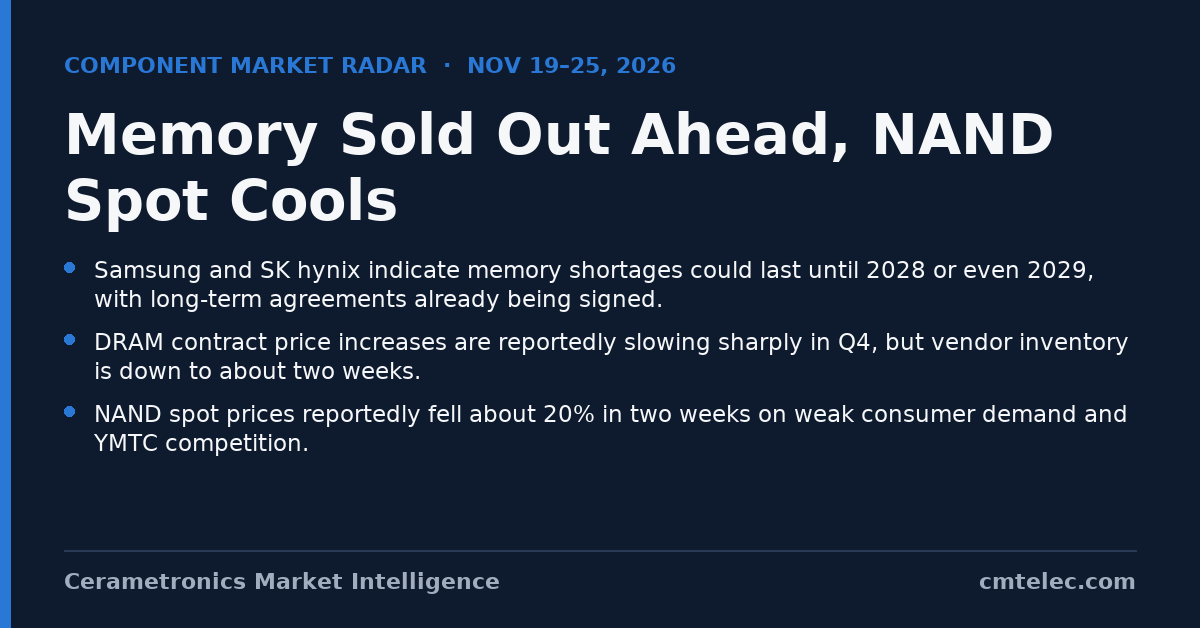
Samsung's memory chief reportedly expects the RAM shortage to peak only in 2028, and next year's HBM output is described as already sold out. Separately, SK hynix reported a record 80% operating margin for the third quarter of 2026. It said DRAM and HBM are effectively sold out through 2029, with 14 customers signed to long-term agreements. For sourcing teams, the message is that supplier capacity is being committed far in advance. Buyers without multi-year visibility may find allocation harder, so forecasting and supply agreements deserve attention now rather than at the next quarterly review. Sources: shattered.io, BigGo Finance, The Globe and Mail.
DRAM contract increases cool, but supplier buffers stay thin
Reports say the Q4 DRAM contract price increase has slowed sharply, from about 80% to about 20%. At the same time, vendor inventory is down to roughly two weeks. A smaller increase should not be read as easing supply: thin buffers leave little room for demand surprises or production disruptions. For buyers, slower hikes may make budgeting slightly easier, but delivery risk remains elevated. Teams should validate quoted lead times with suppliers and avoid assuming that slowing price momentum means better availability. These figures come from public reports and have not been independently verified. Sources: feng.ifeng.com, BigGo Finance, XenoSpectrum.
NAND spot prices fall about 20% in two weeks
NAND spot prices have reportedly reversed course, sliding around 20% in two weeks. Coverage attributes the drop to weak consumer demand and stronger competition from YMTC. The move is a reminder that the memory market is not uniformly tight: NAND is behaving differently from DRAM and HBM. Buyers with consumer-oriented NAND needs may find more room to negotiate, while holders of excess inventory face pressure to sell quickly. Spot moves can be volatile and do not always carry into contract terms, so purchasing decisions should weigh both channels carefully. Sources: XenoSpectrum, TrendForce, Tom's Hardware.
Samsung plans large AI-focused NAND expansion in Xi'an
Samsung reportedly plans to raise AI data center NAND output at its Xi'an plant to five times its current level. If carried out, the expansion could reshape the enterprise SSD supply outlook, particularly as AI infrastructure demand pulls capacity toward data center products. The reports reviewed do not give a timeline, so the practical effect on availability is uncertain. Buyers of enterprise storage should watch for how this capacity shift interacts with softer consumer NAND pricing. Sourcing teams should also consider the supply-chain risk of relying on a single manufacturing location. Sources: Seoul Economic Daily, Seoul Economic Daily, TrendForce.
DDR5 price surge and 2027 allocation warnings
MyDrivers reports that a DDR5 price index has risen 607%, and that memory makers are warning that parts could be hard to obtain in 2027 even for buyers willing to pay. Coverage of this specific story is limited, so it is best treated as a directional indicator rather than a confirmed forecast. It is consistent with the longer shortage timelines described by Samsung and SK hynix. For procurement teams, the practical implication is that allocation access, not only price, may become the constraint, which makes early engagement with suppliers on 2027 volumes worthwhile. Sources: MyDrivers, JW Insights.
Foundry price hikes signal higher MCU and analog costs
Chinese foundry Hua Hong has disclosed plans to raise product prices by an average of 10% to 15% in 2026. Because mature-node foundries underpin many microcontrollers and analog devices, such increases can feed into component pricing for those categories. The report comes from a single source, so the pass-through timing and extent for individual suppliers remain unclear. Sourcing teams should ask MCU and analog suppliers about upcoming price notices, review how cost increases are handled in current agreements, and consider whether earlier commitments for 2026 volumes make sense. Sources: 36Kr.
Server makers raise prices and CPU supply tightens
Single-source reports say HPE, Dell and Lenovo are raising AI server prices by 45%, months after contracts were signed, with the memory shortage cited as the cause. A separate report says Intel can cover only about half of CPU demand while prices rise. If accurate, these points show cost pressure moving downstream and signed prices not always being final. Buyers of servers and related components should check price-adjustment and cancellation terms in existing contracts. Teams planning server CPU needs should confirm allocation early. Both claims remain unverified public reports. Sources: TechRadar, Longbridge, Foro3D.
What it means for sourcing
- Extend demand forecasts to 2027 and beyond, and discuss multi-year supply agreements with memory suppliers, since suppliers are reportedly committing capacity years ahead.
- Treat memory segments separately: do not apply DRAM tightness to NAND. Use softer NAND spot conditions selectively, and verify authenticity and traceability on any spot purchase.
- Review price-adjustment clauses in current contracts, and ask MCU, analog and server suppliers about expected 2026 cost increases so budgets reflect possible pass-through.
For the full data behind these signals, read this week’s Component Market Insights. Questions about a specific sourcing situation? Contact us or write to [email protected].
Compiled by Cerametronics from public reports linked above; not independently verified. For information only — not a forecast or an offer.
Sourcing components mentioned in this article?
Inquire About These Components →Stay ahead of shortages
Get this market brief every week
Weekly: EOL notices, lead-time moves and allocation signals — 5 minutes, no sales pitches.
Need Urgent Stock or Better Pricing for These Components?
Component Market Insights: Nov 16 – 22, 2026 — What Last Week’s Data Means for Sourcing This Week
Automotive demand is moving from the lamp to the links: interface parts led last week, power held and lighting drivers cooled.
Component Market Radar: Nov 12–18, 2026 — Memory tightness lingers as MCU price hikes loom
Memory shortage forecasts stretch to 2028, NAND spot prices slide, and ST and Hua Hong signal price increases. Weekly sourcing signals for buyers.
Component Market Insights: Nov 9 – 15, 2026 — What Last Week’s Data Means for Sourcing This Week
Automotive demand didn't cool last week. The pull widened to the power stage and general-purpose MCUs.
Component Market Radar: Nov 5–11, 2026 — Memory Sold Out for Years as AI Demand Climbs
Component Market Radar: memory makers say DRAM and HBM are booked for years, Q4 DRAM hikes slow, and AI spending lifts capacity plans. Sourcing takeaways.