
Share
Need Urgent Stock or Better Pricing for These Components?
Published: November 12, 2026
Data window: Nov 5–11, 2026
Memory suppliers now describe tightness in multi-year terms, with long-term agreements absorbing capacity while contract price increases slow only modestly and new capacity arrives gradually.
This week’s signals
SK hynix says DRAM and HBM are effectively booked through 2029
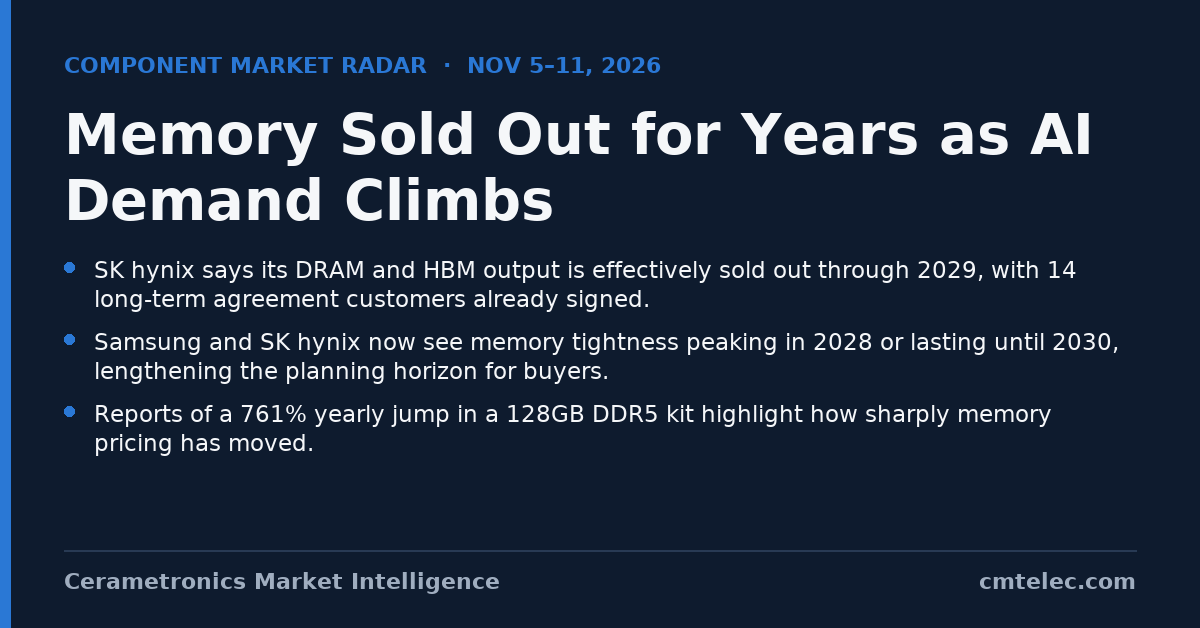
SK hynix reported a record operating margin of 80% for the third quarter of 2026. It said its DRAM and HBM output is effectively sold out through 2029 and that it has signed long-term agreements with 14 customers. For buyers, the message is that supply is being allocated years ahead through contracts, which leaves less volume for short-notice orders. Procurement teams without multi-year arrangements should check how exposed their memory roadmaps are and open capacity conversations with suppliers and channel partners early. Sources: The Globe and Mail, PCMag.
Memory makers extend the expected shortage horizon to 2028–2030
Two of the largest memory producers have now publicly lengthened their outlooks. Samsung's memory chief reportedly expects the RAM shortage to peak only in 2028, and says next year's HBM output is already sold. SK hynix reportedly expects memory shortages to last until 2030. The two views differ on timing, but both point to a prolonged period of constrained supply instead of a short cycle. Buyers should stop assuming a quick normalization in product-cost models and review forward buying, safety stock policy and supply contract terms accordingly. Sources: shattered.io, Money Today, PCWorld, Evertiq.
Reported DDR5 price surge shows how far the market has moved
Chinese-language reports say a 128GB DDR5 memory kit has risen about 761% in price over a year, and describe the market as out of control. These are retail-oriented figures and may not match contract conditions for OEM and EMS buyers. Still, they show how quickly pricing can detach from historical norms when supply is tight. Teams should re-check memory costs in their bills of materials, test margin sensitivity to further increases, and confirm which products carry the greatest exposure to DDR5 pricing. Sources: MyDrivers, Sina Finance.
DRAM contract increases slow in Q4, yet vendor inventory is thin
Reports indicate that the expected fourth-quarter DRAM contract price increase has fallen from roughly 80% to about 20%. A slower rise could look like relief, but the same coverage says vendor inventory has dropped to around two weeks. Thin buffers mean any disruption or demand surge could quickly tighten availability again. Buyers should treat the slower pace as a change in rate, not direction, and avoid delaying commitments in the hope of a price pullback. Confirm delivery schedules and allocation status for upcoming quarters. Sources: feng.ifeng.com, BigGo Finance.
Micron's AI memory is booked out while a large plant is paused
Micron reportedly says its AI memory chips are sold out through 2026, with some capacity committed into 2028. Separate reports say the company has halted construction of a $4.5 billion memory plant while the global shortage continues. Together these signals suggest that new supply will not arrive quickly and that existing output is already spoken for, especially in HBM. Sourcing teams should not count on fresh capacity easing conditions soon. Include alternate qualified sources and flexible designs in planning where memory content is significant. Sources: Startup Fortune, TradingKey, Mezha, TradingView.
Samsung begins work on an HBM packaging plant in Asan
Samsung is reportedly breaking ground on an HBM packaging facility in Asan, adding to advanced memory capacity over time. Packaging is a recognized constraint for HBM, so additional capability is a constructive sign for that segment. However, a groundbreaking is only the start of a multi-year ramp, and HBM competes for wafer and manufacturing resources with other DRAM products. Buyers of conventional DRAM should monitor how HBM expansion affects availability of related products, instead of assuming new capacity will quickly relieve broader tightness. Sources: Seoul Economic Daily, Money Today.
AI spending drives capacity growth beyond memory, including MLCCs
Murata has announced a ¥1 trillion investment to expand MLCC production, aiming to double capacity by 2030 with AI data centers as a stated target. Meanwhile, hyperscaler capital spending is projected at $828 billion for this year, pointing to continuing demand for AI server components. The MLCC build-out is a long-term positive for passive supply, but the timeline is years, not months. Buyers should watch for AI-related demand pulling allocation toward data-center parts. These items rely on public reports that have not been independently verified. Sources: EE Times China, Evertiq, AOL.com, Fortune.
What it means for sourcing
- Open long-term agreement or capacity-reservation discussions for memory now, and map which products depend on DRAM and HBM-adjacent supply beyond 2027, since suppliers describe commitments extending to 2029.
- Refresh BOM cost scenarios with higher memory assumptions through at least 2028, and flag programs where a slower Q4 increase could be mistaken for the start of a price decline.
- Qualify alternate sources and design-flexible memory options early, and track capacity news for MLCCs and other passives so AI-driven demand does not catch non-AI product lines unprepared.
For the full data behind these signals, read this week’s Component Market Insights. Questions about a specific sourcing situation? Contact us or write to [email protected].
Compiled by Cerametronics from public reports linked above; not independently verified. For information only — not a forecast or an offer.
Sourcing components mentioned in this article?
Inquire About These Components →Stay ahead of shortages
Get this market brief every week
Weekly: EOL notices, lead-time moves and allocation signals — 5 minutes, no sales pitches.
Need Urgent Stock or Better Pricing for These Components?
Component Market Insights: Nov 2 – 8, 2026 — What Last Week’s Data Means for Sourcing This Week
Automotive demand didn't cool last week. It spread from lighting drivers to the whole body controller.
Component Market Radar: Oct 29–Nov 4, 2026 — Memory Shortage Stretches Toward 2030
Samsung and SK hynix signal memory tightness into 2028–2030, DDR4 overtakes DDR5, MLCC lead times hit 52 weeks, and NXP plans price rises.
Component Market Insights: Oct 26 – Nov 1, 2026 — What Last Week’s Data Means for Sourcing This Week
Automotive analog is the new tight spot, AI servers are gated by CPUs and power ICs, and memory runs at two speeds. What last week's data means for sourcing.
Component Market Insights: Oct 19–25, 2026 — What Last Week’s Data Means for Sourcing This Week
Component market signals for Oct 19–25, 2026: automotive power demand, isolation momentum and protection price pressure, plus sourcing actions for this week.