Share
Need Urgent Stock or Better Pricing for These Components?
Published: November 19, 2026 | Updated: November 18, 2026
Data window: Nov 12–18, 2026
Memory supply is signaled tight for years even as NAND spot prices soften, while MCU and analog suppliers move toward further price increases heading into 2027.
This week’s signals
SK hynix says DRAM and HBM effectively sold out through 2029
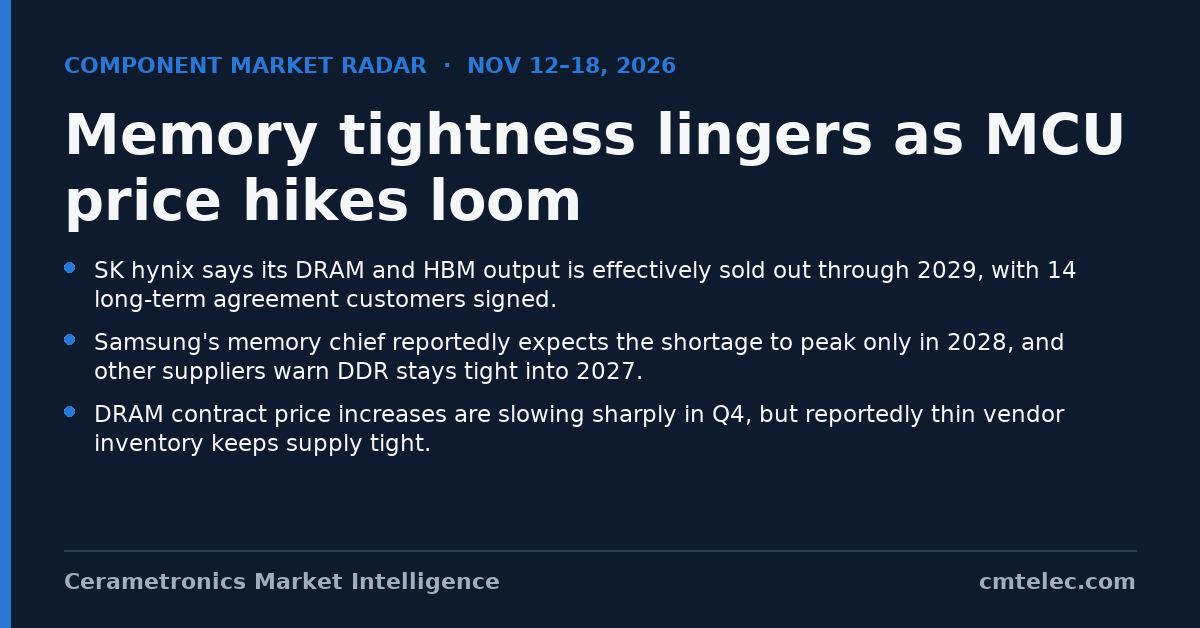
SK hynix reported a record operating margin of 80% for the third quarter of 2026. It said its DRAM and HBM output is effectively sold out through 2029, with 14 customers already signed to long-term agreements. For buyers, this suggests suppliers are prioritizing committed multi-year demand, leaving less room for spot or short-notice requirements. Procurement teams that rely on quarterly purchasing may find allocation harder to obtain, so early talks about multi-year commitments and forecast sharing matter more. These figures come from company commentary relayed in public reports and have not been independently verified. Sources: TrendForce, Android Headlines.
Samsung memory chief sees shortage peaking only in 2028
Samsung's memory chief reportedly expects the RAM shortage to peak only in 2028, and next year's HBM output is said to be already sold out. Separate reports cite memory makers warning that DDR supply will stay tight into 2027, with a DDR5 price index described as up 607%. Together, these messages point to prolonged tightness rather than a short cycle. Sourcing teams should extend planning horizons beyond a single budget year, review designs that depend on one memory type, and qualify alternates where feasible. Sources: Startup Fortune, Seoul Economic Daily, MyDrivers.
DRAM price increases slow, but supplier buffers stay thin
Reports indicate DRAM contract price increases are slowing sharply in the fourth quarter, from roughly 80% to about 20%. Vendor inventory is said to have fallen to around two weeks, so supply remains tight. Another report cites memory prices up 369% year over year on AI data center demand. A slower pace of increases should not be read as relief: thin supplier buffers mean any disruption could quickly reprice the market. Buyers should treat the moderation as a window to secure allocation rather than wait for declines. Sources: shattered.io, 199IT, TechRadar.
STMicroelectronics reportedly plans another increase from January 2027
STMicroelectronics is reportedly planning a price increase effective January 1, 2027, following three rounds in 2026, citing supply chain costs. The report comes from a single outlet, so details may change, but the direction matters for MCU and analog buyers. Budgets and cost-down targets for 2027 may need to absorb higher component costs. Buyers should ask suppliers how the change applies to open orders and review bill-of-materials exposure to ST devices before year end. Sources: TrendForce.
NAND spot prices reverse sharply on weak consumer demand
NAND spot prices have reportedly reversed, falling about 20% in two weeks as consumer demand weakens and competition from YMTC intensifies. This contrasts with the tight DRAM picture and shows memory is not moving in a single direction. For sourcing, flash-heavy products may see softer spot pricing, which could add pressure to contract negotiations. Buyers should review pending commitments, avoid assuming the DRAM pattern applies to flash, and watch whether spot weakness spreads into contract pricing. Sources: TrendForce, TrendForce, ad-hoc-news.de.
Foundry price hikes of 10–15% add pressure on MCU and analog
Chinese foundry Hua Hong has reportedly disclosed plans to raise product prices by an average of 10% to 15% in 2026. Foundry pricing feeds directly into the cost of MCUs and analog devices built on mature processes, so such increases tend to move downstream into component pricing over time. Combined with the reported ST increase, this suggests cost pressure in mature-node semiconductors beyond memory. Buyers should ask suppliers about foundry cost pass-through and factor potential increases into 2027 planning. Sources: guandian.cn, Cailian Press.
Samsung and SK hynix push new HBM-focused capacity
Samsung is set to break ground on an HBM packaging plant in Asan, while SK hynix is reportedly running construction around the clock to complete a large new fab. Both point to additional AI-focused memory capacity ahead. Because these projects take time and primarily target HBM, near-term relief for conventional DRAM remains uncertain. Over time, new capacity could reshape allocation between HBM and standard products. Buyers should track commissioning timelines and avoid plans that assume quick easing of tightness. Sources: The Korea Herald, Nikkei Asia, digitimes.
What it means for sourcing
- Extend memory demand forecasts to cover 2027 and 2028, and open early discussions on long-term agreements or allocation commitments with suppliers and authorized channels.
- Include the reported ST increase and foundry cost pass-through in 2027 budgets, and ask suppliers how new pricing applies to open and scheduled orders.
- Treat softer NAND spot pricing as separate from DRAM. Review flash commitments for renegotiation opportunities, and avoid assuming the same trend applies to DRAM or HBM-linked products.
For the full data behind these signals, read this week’s Component Market Insights. Questions about a specific sourcing situation? Contact us or write to [email protected].
Compiled by Cerametronics from public reports linked above; not independently verified. For information only — not a forecast or an offer.
Sourcing components mentioned in this article?
Inquire About These Components →Stay ahead of shortages
Get this market brief every week
Weekly: EOL notices, lead-time moves and allocation signals — 5 minutes, no sales pitches.
Need Urgent Stock or Better Pricing for These Components?
Component Market Insights: Nov 9 – 15, 2026 — What Last Week’s Data Means for Sourcing This Week
Automotive demand didn't cool last week. The pull widened to the power stage and general-purpose MCUs.
Component Market Radar: Nov 5–11, 2026 — Memory Sold Out for Years as AI Demand Climbs
Component Market Radar: memory makers say DRAM and HBM are booked for years, Q4 DRAM hikes slow, and AI spending lifts capacity plans. Sourcing takeaways.
Component Market Insights: Nov 2 – 8, 2026 — What Last Week’s Data Means for Sourcing This Week
Automotive demand didn't cool last week. It spread from lighting drivers to the whole body controller.
Component Market Radar: Oct 29–Nov 4, 2026 — Memory Shortage Stretches Toward 2030
Samsung and SK hynix signal memory tightness into 2028–2030, DDR4 overtakes DDR5, MLCC lead times hit 52 weeks, and NXP plans price rises.