
Share
Need Urgent Stock or Better Pricing for These Components?
Published: November 5, 2026
Data window: Oct 29–Nov 4, 2026
Memory makers now describe tightness lasting years, not quarters, and pressure is spreading to legacy DRAM, passive components, automotive chips and enterprise storage. Buyers should plan on longer horizons.
This week’s signals
Samsung sees memory shortage worsening through 2027, peaking in 2028
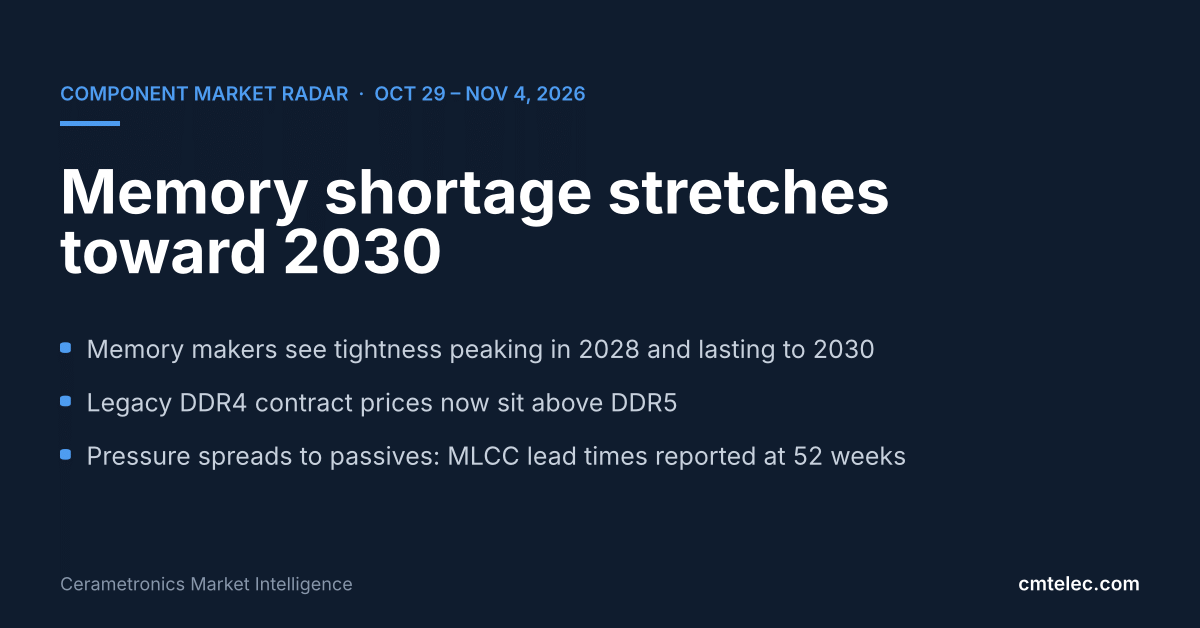
Samsung's memory leadership was reported to expect the current DRAM shortage to peak only in 2028, with conditions worsening through 2027. Coverage also says next year's HBM output is already committed and that roughly 70% of capacity is secured by customers under long-term agreements. That leaves a thin slice of supply for spot and short-contract demand. Planners at OEM and EMS companies should assume multi-year tightness rather than a short cycle. Forecasts, alternate-part qualification and commitment horizons all deserve a fresh look. These are public reports and are not independently verified. Sources: Startup Fortune, Wccftech, Businesskorea.
SK hynix expects shortage to last until 2030, DRAM sold out to 2029
SK hynix was reported to expect memory shortages to last until 2030, citing sustained AI demand. Alongside a record third-quarter operating margin of 80%, the company said DRAM and HBM are effectively sold out through 2029 and that it has signed 14 long-term agreement customers. Together with Samsung's outlook, this suggests the two largest suppliers are prioritising committed, multi-year volumes. Buyers without such agreements may face longer allocation queues and less flexibility on delivery dates. Procurement teams should check whether current supply contracts and forward-buy policies reflect a horizon of years rather than quarters. Sources: Techzine Global, TweakTown, TrendForce.
DDR4 contract prices overtake DDR5 after 24% quarterly climb
Reports indicate DDR4 contract prices rose 24% over three months and now sit above DDR5. Legacy memory is often assumed to be the cheaper, easier-to-source option for industrial, automotive and embedded designs that have not migrated. The inversion points to tightening supply for older generations, which may reflect capacity moving toward newer products. For sourcing teams, this undermines the idea that older-generation parts are a safe fallback. It raises the value of end-of-life planning, redesign evaluations where feasible, and early supply discussions for products still built on DDR4. Sources: MyDrivers, XenoSpectrum.
Samsung Electro-Mechanics MLCC lead times reportedly reach 52 weeks
Samsung Electro-Mechanics MLCC lead times were reported to have lengthened to 52 weeks, meaning orders placed now would deliver only next year. MLCCs sit on nearly every board, so extended lead times at a major supplier can ripple across consumer, industrial and automotive builds. The shortage story is no longer confined to memory. Buyers should check passive-component exposure in their bills of materials and confirm approved alternates from other manufacturers. Order timing should follow real build schedules rather than the historically short lead times once typical for passives. Sources: East Money, BigGo Finance.
NXP plans automotive price increases from January 1, 2027
NXP was reported to plan price increases on some automotive product lines effective January 1, 2027. The clear effective date helps cost planning, but it also signals that pricing pressure is spreading beyond memory into automotive semiconductors. The summary did not specify which lines are affected, so buyers should confirm scope directly with their suppliers. Automotive and industrial customers may want to review open purchase orders, price validity periods and the timing of year-end commitments before the change takes effect. Early conversations can also help clarify any transition terms. Sources: guandian.cn, East Money.
SK hynix says HBM demand exceeds supply capacity more than twofold
On its earnings call, SK hynix reportedly said HBM demand exceeds its supply capacity by more than two times. HBM is tied directly to AI accelerators, yet a gap this large can pull supplier priority and investment attention away from conventional memory. Buyers of mainstream DRAM and related products should expect suppliers to keep favouring high-value AI allocations. That argues for planning around allocation and committed volumes rather than assuming open-market availability. Engineering and purchasing teams should also discuss which designs could tolerate alternate densities or suppliers. Sources: Money Today, Seoul Economic Daily.
Western Digital: 2026 HDD capacity sold out, orders reach 2030
Western Digital was reported to say its 2026 hard-drive capacity is fully sold out, with enterprise drive orders booked as far out as 2030, and it described storage as a hard bottleneck for AI buildouts. Enterprise HDD tightness matters to server, storage and data-center integrators. It may also push some buyers toward flash alternatives, adding demand to an already constrained memory market. Teams sourcing storage subsystems should plan drive requirements well ahead. Where designs allow, qualifying more than one capacity point or media type can add flexibility. Sources: MyDrivers, cnBeta.COM.
What it means for sourcing
- Extend demand forecasts and supply commitments to a multi-year horizon, and open long-term agreement talks with memory suppliers or authorized channels before allocation tightens further.
- Audit bills of materials for exposure to legacy DDR4, MLCC passives and automotive lines facing price changes, and qualify second-source alternates early.
- Review open purchase orders, price validity windows and year-end ordering ahead of the January 1, 2027 NXP change, and align order timing with firm build schedules.
For the full data behind these signals, read this week’s Component Market Insights. Questions about a specific sourcing situation? Contact us or write to [email protected].
Compiled by Cerametronics from public reports linked above; not independently verified. For information only — not a forecast or an offer.
Sourcing components mentioned in this article?
Inquire About These Components →Stay ahead of shortages
Get this market brief every week
Weekly: EOL notices, lead-time moves and allocation signals — 5 minutes, no sales pitches.
Need Urgent Stock or Better Pricing for These Components?
Component Market Insights: Oct 26 – Nov 1, 2026 — What Last Week’s Data Means for Sourcing This Week
Automotive analog is the new tight spot, AI servers are gated by CPUs and power ICs, and memory runs at two speeds. What last week's data means for sourcing.
Component Market Insights: Oct 19–25, 2026 — What Last Week’s Data Means for Sourcing This Week
Component market signals for Oct 19–25, 2026: automotive power demand, isolation momentum and protection price pressure, plus sourcing actions for this week.
Week 42, 2026 — Electronics Component Industry Highlights
📊 Week 42, 2026 — Electronics Component Industry Highlights 📅 October 12 – October 18, 2026 The bottleneck has moved from wafers to power
Component Market Radar, 2026 Week 42: Optical Sold Out Into 2029, Memory Markets Diverge
A leading US optical supplier reports capacity sold out into early 2029, while memory spot prices split by generation and CPU price hikes are reported. Here is what sourcing teams should watch this week.